A flash. Undertale, Spinoza, and the inevitable questions of philosophy
 Andy Warhol, Heart (1979). The Andy Warhol Foundation for the Visual Arts.
“Writers, poets, musicians, filmmakers—painters too, even chance readers—may find that they are Spinozists; indeed, such a thing is more likely for them than for professional philosophers. It is a matter of one's practical conception of the 'plan.' It is not that one may be a Spinozist without knowing it. Rather, there is a strange privilege that Spinoza enjoys, something that seems to have been accomplished by him and no one else. He is a philosopher who commands an extraordinary conceptual apparatus, one that is highly developed, systematic, and scholarly; and yet he is the quintessential object of an immediate, unprepared encounter, such that a nonphilosopher, or even someone without any formal education, can receive a sudden illumination from him, a 'flash.'”
— Gilles Deleuze1
Warning: there are spoilers for Undertale throughout this text. If you haven't played it, consider this a recommendation. On another note, my readings of Spinoza are recent. The imprecisions are mine; the intuitions, I hope, also.
I. In 1677, the year of his death, Baruch Spinoza's friends published the Ethics Demonstrated in Geometrical Order, a philosophical system he had decided not to publish during his lifetime to avoid censorship. In 2015, Toby Fox released Undertale, a role-playing game developed almost single-handedly in which the player can complete the entire story without killing anyone. Three centuries and immeasurable worlds separate them. Toby Fox did not read Spinoza.2 But the questions that organize his world are Spinozist questions: what does it mean to persevere in one's being? What link is there between potency and ethics? Can there exist a way of life that amplifies the capacity to act of everyone involved? Undertale answers with game mechanics and with a button you can choose not to press.
II. Among the concepts of the Ethics, the conatus is the one that most directly connects with Undertale. In proposition 6 of Book III, Spinoza writes: “Each thing, as far as it can by its own power, strives to persevere in its being”.3 The conatus is the very essence of each existing thing, what something is as long as it continues to be.
In Undertale, that structure also has a name. Determination allows characters to persist beyond death, to save their state in the world, to return from where one normally cannot return; it is the force that sustains the SAVE system, that mechanic the game elevates to narrative category (it knows the player saves and loads, and makes that gesture part of the story). Courage, hope, will to power are words that fail to capture it. Determination is the inertia of being, the tendency of what exists to keep existing, magnified until it becomes a cosmological principle.
The parallel might seem terminological; both systems speak of persevering. But there is more. In Spinoza, the conatus varies in intensity, in complexity, in the capacity to affect and be affected. In Undertale, determination is also differential: Frisk has it to an extraordinary degree; the monsters, to lesser degrees; Flowey, who died and was resurrected as a flower without a soul, can no longer feel anything. Determination, like the conatus, admits of degrees.
III. For Spinoza, what increases the power to act is good; what reduces it, bad. The good is the direction in which the conatus is fully realized, the movement by which a being deploys its capacity to affect and be affected. To act well is to act from one's own potency, without remaining at the mercy of passions that traverse us without our understanding them.4
Undertale embodies this in mechanics with a precision one does not expect from a video game. The game offers three routes: pacifist, neutral, and genocide. In the pacifist route, the player does not kill any monster; in the genocide route, they kill them all. The difference operates on two registers at once, moral and functional. The genocide route grants more EXP, more immediate combat power. As it progresses, the dialogues empty out, the characters stop reacting, and the world becomes more silent and more gray. The capacity to act, in the Spinozist sense, decreases. The character grows stronger and, at the same time, less.
The pacifist route, on the other hand, demands something else. It proposes understanding each monster, finding the ACT that dissolves the conflict without violence. It is an exercise in affective knowledge, insofar as each encounter demands reading the other, grasping what moves them, what hurts them, what liberates them. The result encompasses the character's survival but exceeds it, insofar as the capacity to act of everyone involved grows. The monsters are freed, the world opens. The ending multiplies joy, that emotion Spinoza associates with the increase of the power to act, with an almost geometrical logic.
IV. Spinoza is also a philosopher of community. In the scholium to proposition 18 of Part IV of the Ethics, he writes that two individuals of entirely equal nature who unite compose an individual twice as powerful as each one separately, and that men can desire nothing better for the preservation of their being than that all should agree in all things.5 The conatus is amplified in the encounter. The individual is more in community than outside of it.
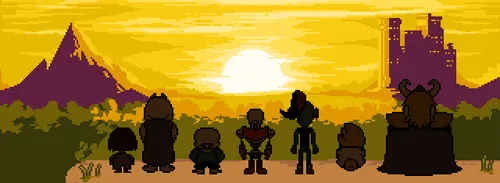
The pacifist ending demonstrates this to the letter. The liberation of the underground world is not produced by a solitary hero who defeats the villain. It is produced by a web of forces. Frisk acts as a catalyst that allows Toriel, Papyrus, Undyne, Alphys, Mettaton, and finally Asriel to recover their own capacity to feel and act. Frisk's determination awakens that of the others. What the ending stages is a politics of affects. The transformation of the world does not come from force but from the capacity to move and be moved, to open in the other a potency that was foreclosed.
Flowey is the exact negative of that principle. When Asriel died and was resurrected without a soul, he lost the capacity to affect and be affected. He can simulate emotions, and does so with manipulative mastery, but he cannot have them. His conatus persists in its most elemental form, existing and acting, emptied of composition. The result is what Spinoza calls servitude: remaining determined by external causes one neither understands nor controls, without any joy arising from one's own nature.
V. The parallel has limits, and it is worth naming them.
The most important is that of agency. In Spinoza, the conatus is necessary; no thing can, by its own nature, seek its own destruction. The ethics that follows from this is an ethics of knowledge.
Undertale requires a decision. Frisk can kill or not kill. The player chooses. That choice carries a moral weight that Spinoza cannot fully articulate in his own terms. For him, whoever does evil does so because their knowledge is inadequate, not because they freely chose to do it. Responsibility in the strict sense has no place in his system. At that point the game comes closer to Kant, insofar as freedom precedes ethics. But it does not stop there. It anchors ethics in concrete affective consequences; it is not enough to choose well, one must produce joy, amplify the potency of others. And that, in a certain way, returns it to Spinoza.
The second limit is more subtle. Spinoza is a philosopher of radical immanence; substance is all there is. Modes are modifications of that unique substance, and their affects are modes of thinking as much as modes of extension. Undertale retains something resembling transcendence; there is a level of the game, that of the real player with their computer and keyboard, that exists above the world of the characters. Sans suspects it.6 Flowey knows it. That consciousness of the meta-level (the possibility of being determined by something that does not even belong to the same plane of existence) opens a dimension that the Ethics excludes by principle. If substance is all there is, there can be nothing that operates from outside of it.
VI. Toby Fox reconstructed a form of immanentist ethics because that kind of ethics has a logic that anyone can recompose when they try seriously to think about what it means to act well without appealing to an external law. The Spinozist version is the most rigorous. That an indie game arrives at similar structures speaks to the internal coherence of certain philosophical problems. Not all philosophy ages the same way: that which is born from inevitable questions perseveres, and keeps finding someone to reinvent it.
Deleuze proposes another way of reading this. In his reading of the Ethics, Spinoza is above all a philosopher of affects, of speeds, of encounters.7 Located this way, his system illuminates any moment in which someone tries to think about what happens when bodies (or characters, or players) affect each other mutually. Undertale is practical philosophy. A field of experimentation in which things that books can only enunciate become visible.
Thus, Undertale can show, in real time, what happens when the capacity to act diminishes. The dialogues short-circuit, the characters have nothing new to say, the world shrinks. The genocide route is an experience of servitude; one feels it before understanding it. The pacifist route does the same in the opposite direction. The world expands, the characters recover something, joy becomes perceptible before you can name it. And that is the most Spinozist thing a game can do: put you in the situation of registering that sadness diminishes and joy composes, before explaining why.
Deep down, playing it, you learn something that the geometrical proposition teaches in another way. That joy is not a state but a bond, that potency grows when shared, that persevering in being finds its fullest form in persevering with others.
— E.
In Spinoza: Practical Philosophy (1981; City Lights Books, 1988). Trans. Robert Hurley.↩
Toby Fox developed Undertale almost single-handedly. His declared influences are EarthBound, Homestuck, and Japanese bullet hell games. No trace of Spinoza.↩
Spinoza, Ethics Demonstrated in Geometric Order, III, P6. Trans. Edwin Curley, Princeton University Press, 1994.↩
Spinoza, Ethics, IV, D1: “By good I shall understand what we certainly know to be useful to us.” Utility is not selfishness but the expression of potency being realized. Cf. IV, P8.↩
Spinoza, Ethics, IV, P18, scholium: “if, for example, two individuals of entirely the same nature are joined to one another, they compose an individual twice as powerful as each one”; and: “Man, I say, can wish for nothing more helpful to the preservation of his being than that all should so agree in all things.” Trans. Edwin Curley, Princeton University Press, 1994.↩
Sans in the genocide route: “It's a beautiful day outside. Birds are singing, flowers are blooming... On days like these, kids like you... Should be burning in hell.” The only character who registers exactly what the player is doing.↩
Gilles Deleuze, Spinoza: Practical Philosophy, trans. Robert Hurley, City Lights Books, San Francisco, 1988 (original: Les Éditions de Minuit, 1981). The final chapter develops this ethological reading: “a mode is a complex relation of speed and slowness, in the body but also in thought, and it is a capacity for affecting or being affected, pertaining to the body or to thought.”↩