Apollo's spit. Truth, knowledge, and authority in the myth of Cassandra
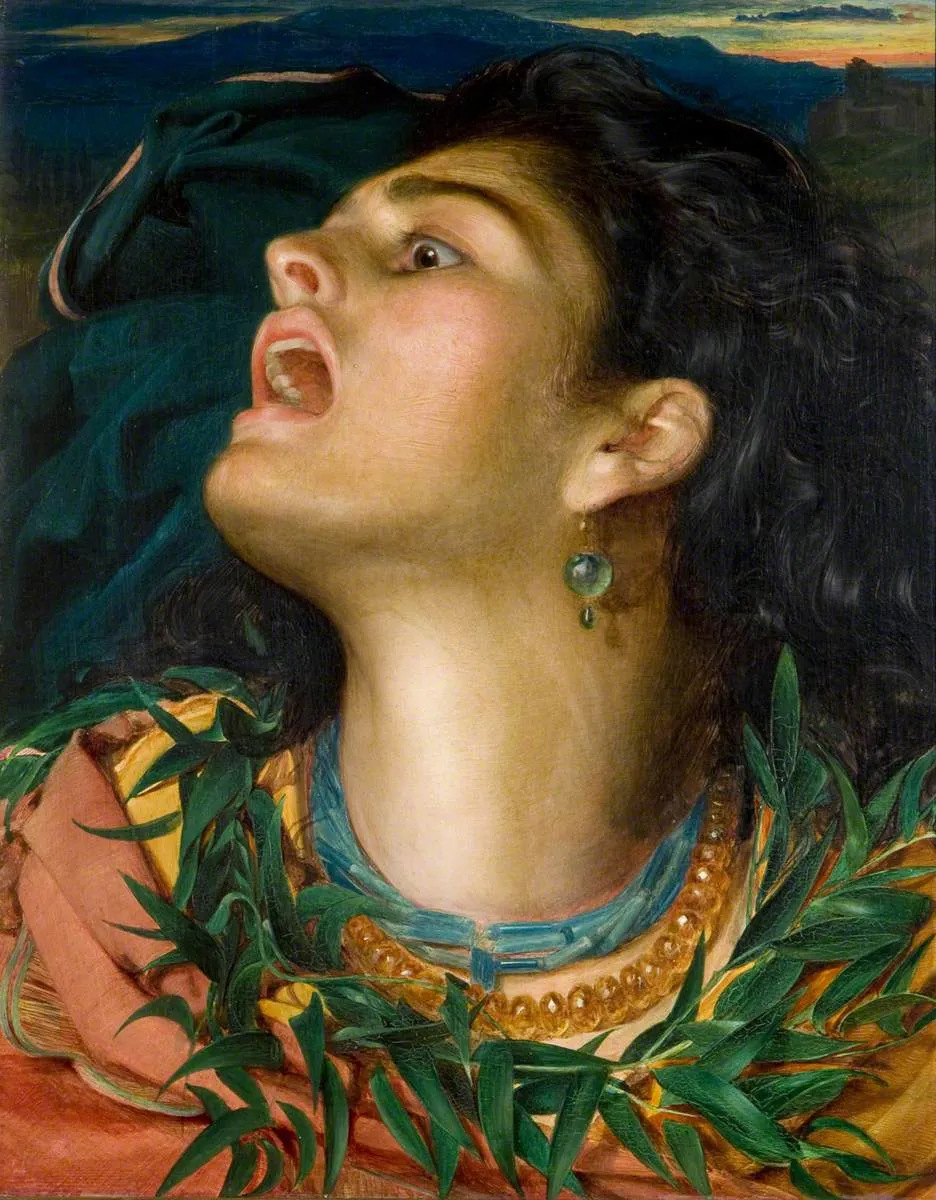
Frederick Sandys, Cassandra, c. 1863–1864. Ulster Museum, Belfast.
The story of Cassandra's curse has several versions. The most widespread says that Apollo gave her the gift of prophecy and that, when she rejected him, he cursed her so that no one would believe her. This explains the expression “Cassandra prophecy,” used for a prophecy that will come true but that no one believes when it is uttered. A late version of the ancient tradition, preserved in a commentary on the Aeneid known as Servius auctus or Servius Danielis, adds that after Cassandra rejected him, Apollo hid his anger for a moment and asked her for “at least a kiss” (osculum saltem), and that when she agreed, he spat into her mouth. Since a god cannot take back a gift, Cassandra went on prophesying the truth, but no one believed her.1
In the shorter commentary, Servius says that Apollo, frustrated in his hope of the sexual encounter he had been promised after granting the gift of divination, “took away the credibility of the one who spoke the truth” (sustulit fidem vera dicenti).2 The phrase is especially useful for separating three terms that in everyday life seem closely tied: truth, knowledge, and authority. Cassandra speaks the truth, in the sense that she prophesies something that will in fact happen. She also knows, since she knows what is going to happen. But she has been stripped of the possibility of speaking from a place that others recognize as such. That place does not belong to her as an individual property. It exists insofar as others recognize that what is said comes from someone who knows.
We can then call authority this relational position, recognition the operation that produces it, and mediations the set of relations, procedures, signs, and so on that make such attribution possible. Apollo's curse artificially dismantles that set and puts each piece apart.
In Aeschylus' Agamemnon, when the chorus asks her about the origin of her gift, Cassandra tells the story of her relationship with Apollo: she first yielded to the god's desire, but later broke her word. Since then, she says, she has not been able to persuade anyone of what she says, although she anticipates that when her prophecies are fulfilled the chorus will recognize her as an alēthómantis, a “true prophetess.”3 That is to say, what her prophecy says remains true, but the path leading from that truth to its recognition by others has been broken.
That broken path is what makes the specific location of the curse, in Cassandra's mouth, so interesting. The mouth has very disparate functions: it is the place of enunciation and of feeding, it is an erogenous zone, and it is also a point of exchange between inside and outside. The version in which Cassandra grants that residual “kiss” and Apollo then spits into her mouth suggests exactly this.
The operation also carries echoes of certain magico-ritual practices involving saliva, and of a similar episode in the myth of Glaucus and Polyidus.4 But the sequence within the scene itself matters too: Apollo desires Cassandra, she withdraws from the position of object that this desire reserves for her, and he ends up intervening in the place from which her words will be addressed to others.
That same sequence makes tempting a reading in which Apollo embodies a dominant position in a patriarchal scheme, the appropriation of power to the detriment of women and their voices. This path is worth taking seriously and there are reasons to pursue it, but the particularity of this curse is that Cassandra keeps her capacity to speak and to know. What is lost is the possibility that both be invested with authority.
“Since you did not allow your body to be occupied by my desire, I will occupy the place from which you speak” could sum up Apollo's spell. The formula is useful, but it needs some clarification.
First, we can note the materiality of the curse, which invades her body through the mouth, the place from which Cassandra speaks. The tradition gives the whole story an erotic undertone. The curse is a punishment for having rejected his desire and it arrives almost as a continuation of a kiss. Even today, when practices involving spit in another person's mouth take place, they can occur in erotic contexts and in practices of humiliation, domination, and so on. Still, we do not need to assume that these codings existed in the ancient world to recognize the ambiguity of the materiality at stake, which acquires a different meaning when the structure of desire that contains it is marked by a refusal, as it is here.
Second, we can see how the “mark” she receives in her mouth acts beyond it, since she does not lose her capacity to use language coherently or to see what is to come.
Third, and perhaps most interesting, the curse does not fall on her knowledge. It operates on the mediation and recognition of that knowledge. Under normal conditions, authority is built: a person's successes can gradually make them someone who is believed. Much of the modern institutions of knowledge rest on this possibility, from degrees to accreditation procedures, peer review, disciplines, archives, and so on. In Cassandra's case, however, the curse annihilates the possibility that, even when her prophecies come true, this counts toward giving her authority in the next ones.
It is on this last point that an interesting connection with psychoanalysis appears. We can invoke transference, one of its fundamental concepts, and Jacques Lacan's formulations on the sujet supposé savoir5 (the subject supposed to know). What matters in this concept is the supposition: the subject in question does not need to actually possess the knowledge.
In Cassandra's case we could think of it the other way around. With the subject supposed to know, one can suppose that someone knows without any guarantee that the knowledge is really there. In her, by contrast, we have a knowledge that exists, but whose possibility of being supposed has been abolished.
Seen this way, the genius of the curse is that the god does not have to show that what she says is wrong, or enter into an argument to refute her discourse. It is much more efficient. He separates truth from whatever authority she might have, because between the two there are mediations, and these can, among other things, be corrupted and spoiled. In other words, the curse works by altering that passage without touching either truth or knowledge.
That same efficiency is also part of its extreme cruelty, of its sublime sadism. Apollo could have taken her voice away. He could have silenced her outright. Seeing the fall of Troy and being unable to speak of it would already have been, as we have said, quite cruel.
But Apollo's curse is to make you speak, in spite of everything...
Here eroticism returns, though no longer in quite the same way as in the opening scene. Apollo cannot have what he wants from Cassandra. What he cannot obtain one way he will obtain another, in another place, and above all every time she is about to speak, every time she is about to go unbelieved.
If we go back to the mouth, something else appears. The word marked by the curse will leave her mouth, but the curse that marks that word has also entered through her mouth. The mouth is the place of entry of something of the other into the body, and we are not speaking of a metaphor here. It is also the place from which discourse will be addressed to others.
Hence the peculiar impotence in the myth of Cassandra. Truth cannot count for anything, and knowledge cannot count for anything on its own. A relation of attribution has to exist that sustains authority over the knowledge and the truth that is spoken. And it is possible that one reason for the persistence of this myth is that many societies, and in particular, as we have seen, modern societies, constantly seek to stabilize that path.
Still, we should not fall into a narcissistic appropriation of this myth. One thing must be kept in mind: Cassandra is right. Not being believed can easily feed the fantasy that others reject a truth too hard to accept. Here the problem is a different one, because the myth guarantees the truth of what Cassandra says. Even so, that truth does not carry with it the set of mediations that would allow its social recognition.
This is what the spit shows, in an ostensible and very material way. The relation between knowledge and authority is altered in the body and in the course that the word will take from the body. The erotic refusal and the intimacy of the kiss, the last one Cassandra grants him, are thus knotted to the curse on her enunciation.
Cassandra's tragedy, in the end, is that none of this stops her from going on telling the truth. She keeps her knowledge and keeps her word, but she speaks from a place stripped of the possibility of making them count before others.
Cassandra will see what others do not see, will know what others do not know, will tell the truth. The curse comes after.
Servius auctus (or Servius Danielis), on Verg. Aen. II 247. See Servii Grammatici qui feruntur in Vergilii carmina commentarii, vol. I, Aeneidos librorum I–V commentarii, ed. Georg Thilo, Leipzig, B. G. Teubner, 1881, p. 260. The scene of the kiss and the spit belongs to the expanded gloss.↩
Servius, on Verg. Aen. II 247: qui spe promissi coitus concessa divinatione frustratus sustulit fidem vera dicenti. See Thilo, Servii Grammatici qui feruntur in Vergilii carmina commentarii, vol. I, 1881, p. 260.↩
Aeschylus, Agamemnon, vv. 1202–1212 and 1241. At v. 1241 the word alēthómantis (ἀληθόμαντις), “true prophetess,” appears.↩
The closest mythical parallel appears in Pseudo-Apollodorus, Library III 3, 2. Polyidus, forced by Minos to teach Glaucus the art of divination, orders him before departing to spit into his mouth; after Glaucus does so, he loses the gift of divination. See Apollodorus, The Library, vol. I, ed. and trans. James George Frazer, Cambridge, Harvard University Press / London, William Heinemann, 1921, p. 313. In his note to the passage, Frazer explicitly connects the episode with Cassandra and also refers to Pliny, Naturalis historia XXVIII 35 ff., which collects a repertoire of protective, therapeutic, and apotropaic uses of saliva.↩
Jacques Lacan, Le Séminaire, Livre XI. Les quatre concepts fondamentaux de la psychanalyse, text established by Jacques-Alain Miller, Paris, Seuil, 1973, session of 10 June 1964, “Du sujet supposé savoir, de la dyade première et du bien,” pp. 209–220. The relevant formulation appears on p. 210: “Dès qu'il y a, quelque part, le sujet supposé savoir […] il y a transfert.”↩