On mirrors and algorithms. Nothing is more recognizable than a well-calibrated illusion
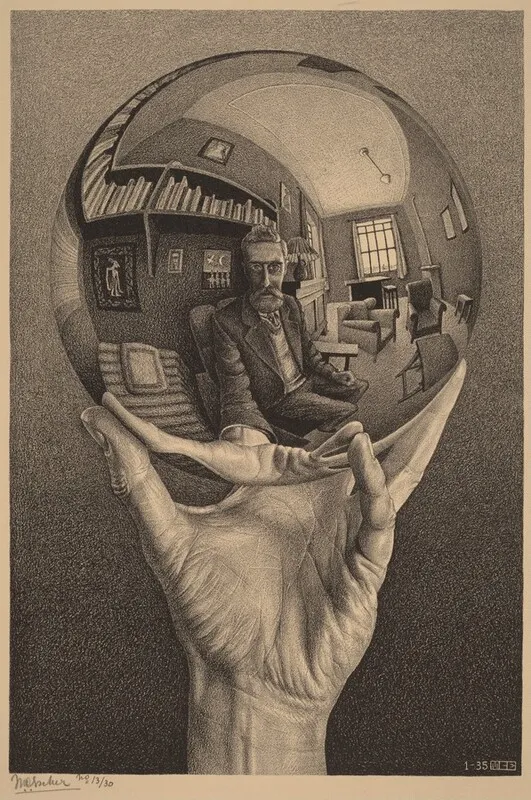
M. C. Escher, Hand with Reflecting Sphere (1935). National Gallery of Art, Washington, D.C.
I. We live in the age of algorithmic recommendation. Systems that filter and rank the information we consume daily are constantly present. Digital platforms such as social networks, streaming services, or online stores offer personalized content based on our data and previous behaviors. This omnipresence reorganizes access to information and transforms how we construct our perception of the world and of ourselves.
Algorithms act like mirrors that return reflections of our preferences, habits, tastes (even prejudices). Each time we scroll, the system suggests content adapted to our interests, and we tend to accept those suggestions because we recognize features of ourselves in that digital reflection (or at least of the image the system has built of us) until we begin to confuse that curated profile with our real identity.
II. Lacan's mirror stage theory offers a useful lens for questioning the illusion of transparency that structures our relationship with algorithms. In that stage, the infant identifies with the unified image seen in the mirror, but that recognition is actually a méconnaissance; an illusory identification with an imaginary unity that conceals inner division. The subject recognizes itself in an idealized image, unaware that the image is, fundamentally, a fiction.
This mechanism of misrecognition now extends beyond infancy and reappears in other self-identification devices. In the contemporary digital environment, recommendation algorithms function as a new mirror. They return an image of our preferences and habits that we perceive as accurate, though it is constructed through opaque calculations, statistical assumptions, and even commercial criteria. This form of méconnaissance describes the illusion through which we interpret these suggestions as a neutral reflection of our subjectivity, ignoring the active processes of selection and filtering behind them.
The digital subject experiences a mixture of recognition and misrecognition. One identifies with the suggested content without realizing that the affinity has been shaped and anticipated. The playlist that seems to express our musical taste, the news feed we believe is neutral, the profile we assume as our own on a social network, the series that “defines us” because “it's exactly what we like,” or the advertisement that addresses us with unsettling familiarity; these are examples of a mirrored image that does not reveal but conceals the technical operations sustaining it. In identifying with our algorithmic profiles, we fall into a form of algorithmic méconnaissance. We believe we are affirming ourselves through that reflection, unaware that it is a partial and often distorted construction.
III. The promise of personalization presents itself as a triumph of convenience (the system knows us and facilitates what we desire) but it carries an ideological dimension. It sustains the belief that the user is sovereign in digital decisions, when in fact that autonomy is deeply conditioned. The algorithm steers choices while the subject believes they are choosing freely. A form of digital false consciousness emerges, where each person feels in control of their online path without perceiving the invisible threads organizing their options.
The ideology of personalization reinforces the idea that each subject inhabits a unique universe of tailored content. But when that universe excludes difference and otherness, subjectivity becomes trapped in a hall of mirrors that returns only refined versions of the already familiar. In this context, personal autonomy seems under threat. If those seemingly free decisions are modulated by opaque algorithmic structures, even if they are not perceived as impositions, they still restrict what is possible.
IV. The algorithm-mirror thus contributes actively to the imaginary formation of the contemporary self. Our subjectivity is shaped by a reflected image that, though familiar and comforting, is a carefully calculated illusion. Algorithmic méconnaissance defines the dominant attitude toward these systems. We trust their advice and adopt their selections as our own, overlooking the structural intervention behind those choices. This willed ignorance enables algorithms to steer collective attention and gradually shape our preferences, influencing what we consume but also how we think and how we perceive ourselves.
Understanding this logic would be a first step toward recovering (at least partially) our autonomy as digital subjects, a degree of cognitive sovereignty before devices that operate by anticipation. The point may not be to “resist” algorithmic méconnaissance as if it were a correctable mistake (in Lacan, every identification necessarily involves a form of misrecognition). But it might still be possible to sustain a less naïve relationship with the reflection. To question the apparent naturalness with which certain content reaches us, to remain open to what is unforeseen or incongruent, to explore without predetermined guidance. All of this can reduce the normative power of the algorithm and return to us, if not a true self, at least a more conscious practice in front of its mirrors. Not necessarily abolish mediation, but, in any case, distance oneself from its imperative of coincidence.
— E.