Rameau versus the Ramones. A short history (or two) of an endless dispute
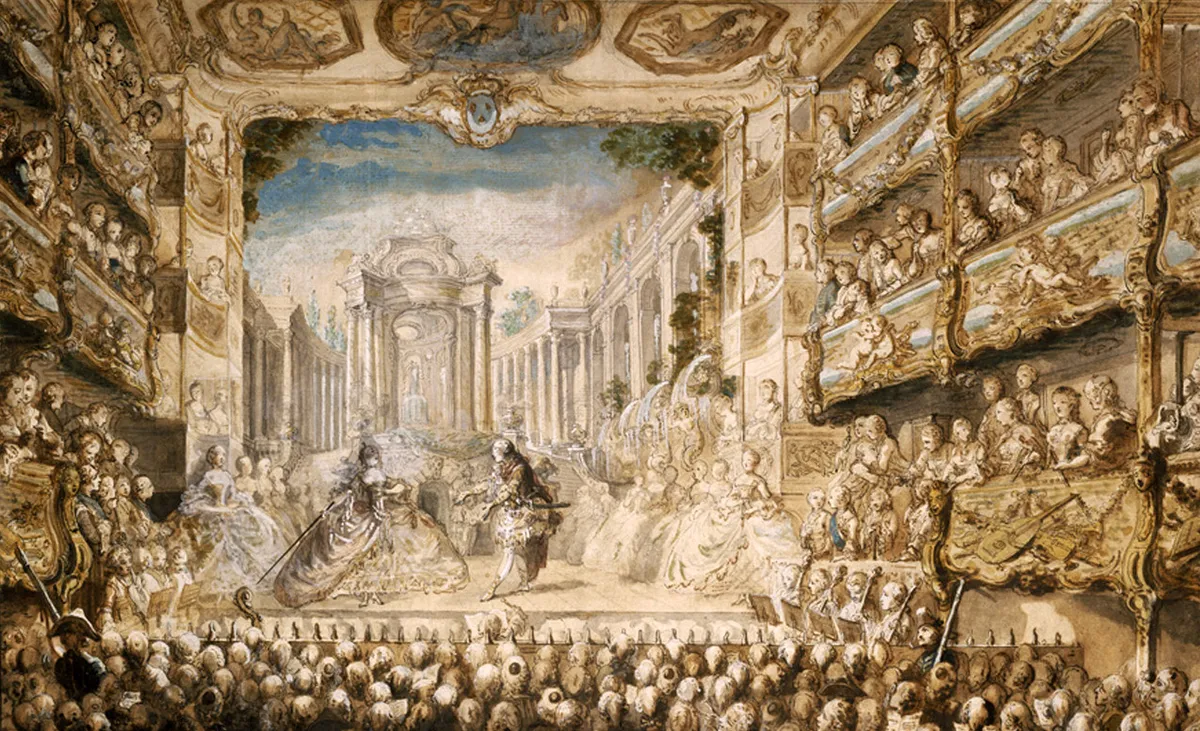
Gabriel de Saint-Aubin, Représentation d'Armide de Lully à l'Académie royale de musique, 1761. Museum of Fine Arts, Boston.
Translations from the French are my own unless otherwise noted.
Paris, 1752. Jean-Philippe Rameau is nearly seventy years old and has spent two decades as France's most important composer. He has tried to found harmonic theory on scientific grounds, written operas that fill the Académie royale, and is convinced that music obeys laws as exact as those of physics. This year he hears an Italian troupe perform a comic trifle by Pergolesi in his own theater, and feels, perhaps with some reason, that he is being used as a target.
The same year, in the same city, Jean-Jacques Rousseau is forty years old and has just premiered his own opera at the palace of Fontainebleau. He is a philosopher, an amateur musician, a theorist of language, and is convinced that European civilization has taken a wrong turn. Rameau's music strikes him as eloquent proof: too calculated, too far removed from the human voice. The following year he publishes the Lettre sur la musique française. It is, among other things, a settling of scores.
Manchester, November 1973. Yes performs Tales from Topographic Oceans at the Free Trade Hall. Eighty-three minutes of music spread across four sides of vinyl, a concept inspired by Hindu scripture, science-fiction sets designed by Roger Dean. Rick Wakeman, the keyboardist, has had little to play for a while. He asks the crew to bring him a curry onstage. While Jon Anderson sings about topographic oceans, Wakeman eats vindaloo leaning against the Hammond. “Half the audience were in narcotic rapture on some far-off planet,” he would recall later. “The other half were asleep, bored shitless.”1
New York, August 1974. In a Bowery bar called CBGB, four kids from Forest Hills, Queens, take the stage in leather jackets and torn jeans. They count off—“one, two, three, four”—and play. Nothing that happened in Manchester nine months earlier happens here. The journalist Legs McNeil, who was there, remembers it this way: “They were all wearing these black leather jackets. And they counted off this song…and it was just this wall of noise… These guys were not hippies. This was something completely new.”2 No song lasts two minutes. It doesn't need to. The two worlds aren't speaking to each other yet, but the British music press is about to declare war: in the pages of NME, Melody Maker, and Sounds, Yes, ELP, and Genesis will be treated for years as the class enemy.3 The dispute that Rameau and Rousseau opened in Paris two hundred years earlier has just found a new incarnation.
I. The object: Italian opera versus French opera
The Querelle des Bouffons of 1752–1754 is usually presented as a dispute between French and Italian opera. Formally, it was. The arrival in Paris of Eustacchio Bambini's touring company with Pergolesi's La serva padrona set off a fierce culture war between defenders of the French lyric tradition and partisans of a more “natural” music. The conflict had its own geography: at the Académie royale de musique, the two camps literally sat on opposite sides of the theater, the coin du Roi facing the coin de la Reine, the court against the philosophes.
But the quarrel was also a battle of the Enlightenment fought by other means. D'Alembert, Diderot, Grimm, and much of the encyclopedist circle sided with the Italians; opera buffa struck them as more direct, closer to natural language, less contaminated by the ceremonial artifice of Versailles. French opera was, in this scheme, a cultural symptom—court music, music of power, that needed all that harmonic architecture precisely because it lacked expressive truth. To attack Rameau was, in part, to attack the Ancien Régime with a Pergolesi score in hand.
Rameau had already been through something like this. Twenty years earlier, the 1733 premiere of Hippolyte et Aricie had set off another quarrel, that of the Lullists against the Rameauists, in which he occupied the place of the accused modernist. Defenders of Lully's tradition attacked him for being too learned, too calculated, too Italianate. The same charges, almost the same words. By 1752, without having changed his music much, Rameau found himself on the other side; now he was the one defending the French tradition against the Italians. Yesterday's defendant, turned today's prosecutor.
Behind the Querelle des Bouffons lay a personal history considerably less noble. In 1745, Rameau heard fragments of Les Muses galantes, an opera Rousseau had presented at the home of the financier La Pouplinière, and reacted with public contempt, accusing him of plagiarism. According to Rousseau himself, from that day Rameau “conceived against me that violent hatred of which he never ceased to give proof until his death.”4 The personal grudge never quite disappeared from the aesthetic debate.
II. The subjects: Rousseau versus Rameau
There was, on top of that, a real technical asymmetry that shaped how the quarrel was fought. Rameau was the only composer among the polemicists, the debate's working musician, and also the most rigorous theorist of harmony in all of France, the man who had tried to found music as a science. When he answered Rousseau in his 1754 Observations sur notre instinct pour la musique, he did so with detailed technical and harmonic analysis,5 point by point, score in hand. On that ground, Rousseau could not win.
Rousseau knew it. His Lettre shifted the debate onto philosophical ground, where the question was no longer which harmonic system was more correct but what conception of human nature lay behind each kind of music. That move connected the musical discussion to his broader theory of civilizational corruption. French music became, in this light, a symptom of the same problem afflicting society at large: artifice displacing nature, convention replacing genuine feeling. The Lettre is, in that sense, something more than a polemic about opera. It is a political essay disguised as musical criticism, and perhaps for that reason it produced something more lasting than the quarrel itself.
III. The technical axis: melody versus harmony
Beneath the feud lay a genuine philosophy of artifice. Both agreed that music imitates nature; the trouble was that they understood “nature” in incompatible ways. Rameau identified it with physical-mathematical order: acoustic laws, the resonance of sounding bodies, the proportion of intervals, the structure of chords. From his 1722 Traité de l'harmonie to his last writings, he tried to turn music into a deductive science, drawing on Descartes and Zarlino to found harmony on mathematical principles.6 Order, proportion, and formal intelligibility intensified aesthetic experience, in his view.
That ambition had a genealogy. Descartes had tried, in his Compendium musicae, to reduce musical experience to geometric proportions. The physicist Joseph Sauveur later demonstrated experimentally the existence of natural harmonics, the frequencies that resonate within any fundamental tone. Rameau took that discovery as confirmation of his system: if the physical nature of sound already produces harmonies, then music that organizes them rigorously follows nature rather than departing from it. Well-constructed artifice was, by that logic, more faithful to nature than disordered spontaneity. The same ambition touched other bodies; it wasn't a private mania of Rameau's but the spirit of the age, the same impulse that led people to mathematically codify, for instance, dance.7
Rousseau started from somewhere else. For him, nature was the inner world of human passion, direct communication, the accents of the speaking voice. And French music, with its obsession with complete harmony, had lost all contact with that origin. So he put it in the Lettre: “I believe I have shown that there is neither measure nor melody in French music [...] that French singing is nothing but continual barking, unbearable to any unprejudiced ear; that its harmony is crude, without expression.”8 This from someone who had composed opera himself, who knew the genre from the inside.
The more elaborate case, though, isn't in the Lettre but in the Essai sur l'origine des langues, written partly as an indirect reply to Rameau and published posthumously in 1781.9 There Rousseau argued that language was born of passion, not need: “It was neither hunger nor thirst, but love, hatred, pity, anger, that wrung from them their first utterances [...] which is why the first languages were song-like and passionate before they were simple and methodical.” Melody was that origin—sung voice, inseparable from the emotion that produced it. Harmony came later, an intellectual abstraction laid over that living foundation. French music, in this scheme, wasn't more complex than Italian music. It was older, in the worst sense. Further from the original cry.
And yet Rameau produces enormous physical intensity. Just listen to the closing chaconne of Les Indes galantes: several minutes of continuous variation over a bass line that never lets up, architecture fully on display, an almost overwhelming effect. Rousseau's question doesn't deny that, but shifts the focus: where does the emotion come from? Rousseau looks for it in expressive transparency; Rameau finds it in the construction of the system itself. It's the same question that, two centuries later, would come between a nineteen-year-old on King's Road and a band filling stadiums with synthesizers.
IV. The reactivation: punk versus prog
London, 1975. John Lydon, nineteen years old, hair dyed green, walks down King's Road in a Pink Floyd T-shirt on which he's scrawled, by hand, in ballpoint pen, “I HATE,” and punched holes through the band members' eyes in the photo. Malcolm McLaren spots him, invites him to a pub that same evening, and a few weeks later Lydon is Johnny Rotten, singer of the Sex Pistols.10 The shirt gets passed around the band, each member taking a turn wearing it onstage. It's the Lettre sur la musique française reduced to a piece of clothing: same attitude, same target—sophistication as betrayal—two centuries later.
Prog shares with Rameau a confident relationship with artifice, namely formal complexity, virtuosity, extended compositions, pleasure in visible construction. Punk reacts in a way close to Rousseau: it's suspicious of virtuosity, it champions physical immediacy. For the rock critics formed in that tradition, “authenticity” was music's central value, and prog betrayed it by diluting it in technical complexity.11 The accusation is centuries old. The asymmetry repeats too; just as Rousseau won by shifting the criteria of judgment rather than winning on technical ground, punk won culturally without improving on virtuosity.
Both traditions caricature each other. Punk hears technical wanking where others hear formal invention. Rousseau hears dead artifice where many listeners today find extraordinary physical intensity. Because that's the paradox of Les Sauvages. Rameau wrote the piece in 1728 for harpsichord after watching two Indigenous dancers perform at the Comédie-Italienne. He took the rhythmic ostinato of that dance, ran it through his harmonic system, and produced something thoroughly rational built on “primitive” material. Seven years later he folded it into Les Indes galantes as an orchestral dance. The relentless repetition, the mechanism laid bare, and yet the body stays caught inside the form. There are moments in that music, and in the harpsichord tambourins too, where French baroque brushes up against something close to minimalism, or to certain strains of electronic dance music. Bare structure, insistent pulse, chords that never resolve, microscopic variation.
Years later, Nick Mason, Pink Floyd's drummer, would end up proving the T-shirt right. Asked about punk's effect on his own genre, he admitted it had done some good: prog, by 1976, “had become so pompous.”12 It's the English, percussive version of Rousseau composing his own opera while accusing French music of being hollow. The sharpest critique of a system tends to come from someone who knows it from the inside.
V. The long history
What's interesting about the 1733 Lullists-versus-Rameauists quarrel isn't just that it anticipated the one in 1752, but that Rameau himself starred in both, on opposite sides. First attacked as the Italianate modernist tearing down Lully's tradition; twenty years later, defending that same tradition against the Italian bouffons. The music hadn't changed that much. What changed was who counted as excessive artifice in the eyes of each generation. That alone should make us suspicious of how stable those criteria really are.
Because the scene, in a sense, keeps reorganizing itself around the same geometry. Artusi attacked Monteverdi at the start of the seventeenth century for introducing “irrational” dissonances into counterpoint—excessive emotional artifice, an abandonment of art's natural rules. Then came Wagner against Brahms, total drama against pure form. Schoenberg against Stravinsky, the twelve-tone system against instinctive neoclassicism. Punk against prog, three chords played with conviction against twenty-minute suites with shifting time signatures. Whoever defends visible construction gets accused of coldness; whoever champions direct expression gets accused of naivety. Nobody convinces anybody.
Today's arguments about artificial intelligence repeat the pattern, with the technical side standing in Rameau's place and threatened authenticity standing in Rousseau's. Neither side convinces the other, same as then.
The 1752–1754 quarrel was brief. It lasted less than two years and ended when the Italian bouffons left Paris. Rousseau kept writing about music; Rameau kept composing operas. But the question they put into circulation—whether formal sophistication opens up new perceptual possibilities or moves art further from direct human experience—found no answer then, and hasn't found one since.
Probably because it doesn't have one.
Wakeman, Rick. Grumpy Old Rock Star and Other Wondrous Tales. London: Preface Publishing, 2007. The curry-onstage anecdote from the Manchester Free Trade Hall, during the Tales from Topographic Oceans tour, is one of the most frequently cited episodes in the book.↩
McNeil, Legs, as quoted in multiple sources since the 1990s, including the documentary End of the Century: The Story of the Ramones (dir. Jim Fields and Michael Gramaglia, 2003). McNeil co-founded Punk magazine (1975) and co-authored Please Kill Me: The Uncensored Oral History of Punk (Grove Press, 1996), where the testimony appears in extended form.↩
The British music press's editorial hostility toward prog is documented across multiple retrospective sources; see, for instance, “1977 was supposedly the year punk killed prog” (Louder Sound / Classic Rock, 2006, reissued 2025), which describes how NME, Melody Maker, and Sounds treated prog as “the class enemy.” This was a sustained editorial stance over years. It's also a partial myth: 1977 was commercially one of the best years for Yes, ELP, and Genesis, all of whom kept filling stadiums while the press declared them dead.↩
Both quotes come from Rousseau's Confessions (written around 1765–1770, published posthumously in 1782), Book VII. The first: “M. Rameau, qui les entendit, conçut contre moi cette violente haine dont il n'a cessé de donner des marques jusqu'à sa mort.” The second is Rousseau's own account of what Rameau allegedly said: “Rameau prétendit ne voir en moi qu'un petit pillard sans talent et sans goût”—“Rameau claimed to see in me nothing but a petty plagiarist without talent or taste.” No independent text by Rameau contains that line; we know it only through Rousseau's telling. For Rameau's version of the episode, see here. Les Muses galantes is available online here.↩
Rameau, J.-Ph. Observations sur notre instinct pour la musique, et sur son principe. Paris: Prault fils, 1754. Available on Gallica.↩
Rameau, J.-Ph. Traité de l'harmonie réduite à ses principes naturels. Paris: Ballard, 1722. Rameau draws on Descartes's Compendium musicae and grounds harmony in the physical resonance of sounding bodies. Available on Gallica.↩
The dancing master Raoul-Auger Feuillet published, in 1700, his Chorégraphie, ou l'Art de décrire la dance par caractères, figures et signes démonstratifs, a system that translated every dance step into circles, lines, and signs, capable of capturing human movement with the same geometric precision Rameau applied to sound. Available on Gallica.↩
Rousseau, J.-J. Lettre sur la musique française, 1753. Full text (in French). The passage continues: “that French airs aren't airs at all; that French recitative isn't recitative at all. From which I conclude that the French have no music and cannot have any; or if they ever do, so much the worse for them.”↩
Rousseau, J.-J. Essai sur l'origine des langues, où il est parlé de la mélodie et de l'imitation musicale. Published posthumously in Geneva, 1781, in a volume of Traités sur la musique. Drafted around 1755–1756, in part as a response to Rameau's pamphlets, though Rousseau chose not to publish it as a direct reply. Full text (in French).↩
The episode is documented, among other sources, in Crack Magazine and Louder Sound. Lydon himself later said he never really hated Pink Floyd: “I've no idea where I got it from, it being green, which was an oddity … not my colour,” he said in a 2010 interview. “Listen, you'd have to be daft as a brush to say you didn't like Pink Floyd.” The shirt was, above all, a gesture of its time.↩
Hung, Eric. “Hearing Emerson, Lake, and Palmer Anew: Progressive Rock as 'Music of Attractions,'” Current Musicology, no. 79/80 (2005), Columbia University. DOI. Open-access PDF. The article systematizes Dave Marsh and Lester Bangs's argument about “authenticity” as rock criticism's dominant standard, and the suspicion that standard casts on prog's virtuosity.↩
Mason, Nick, quoted in Louder Sound, “Did Sex Pistols and Pink Floyd really hate each other?” (2023). Full quote: “I think it was a good thing in terms of dealing with prog rock — which had become so pompous, really.”↩